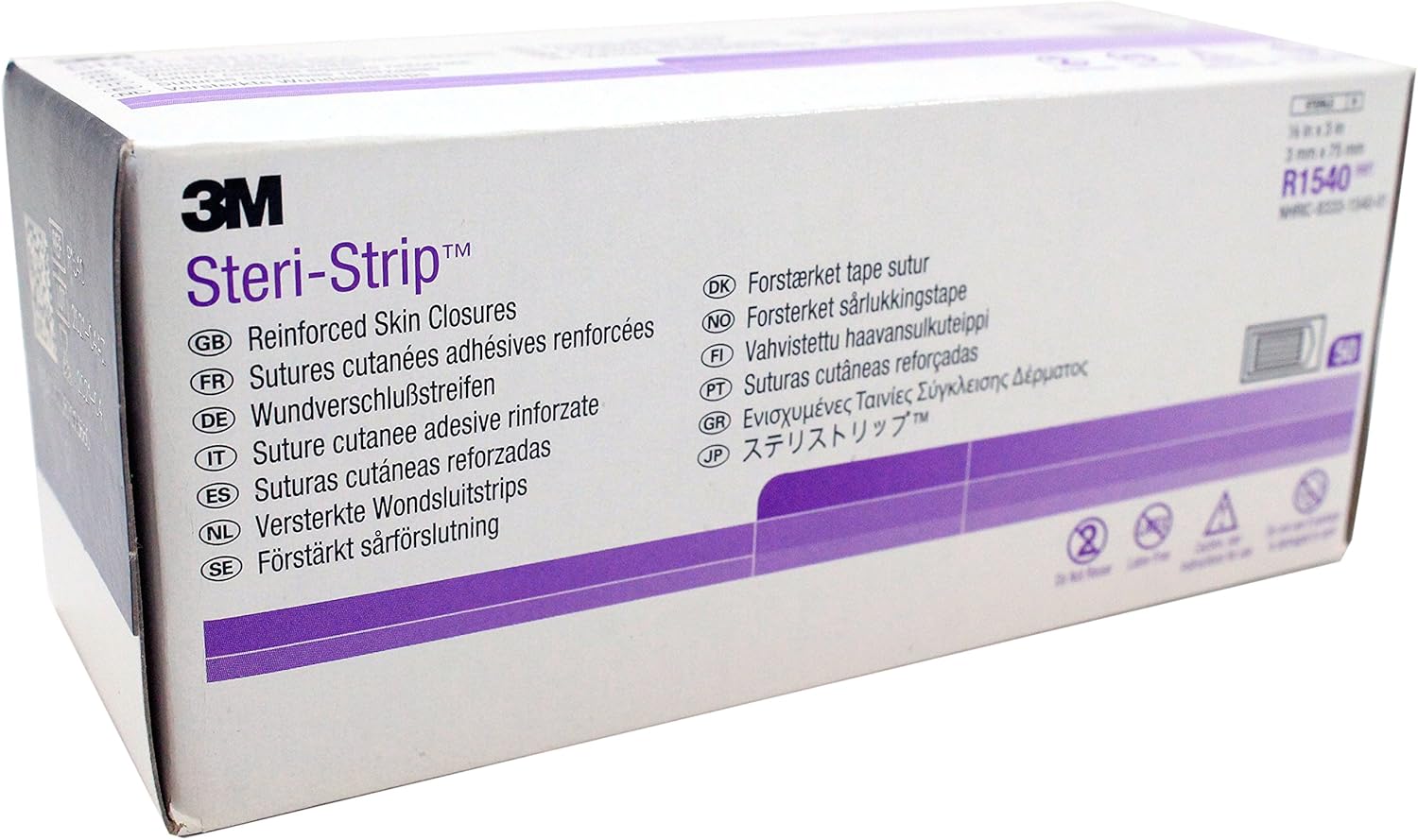
Living With the 3M Steri-Strip Wound Closure Strips
The clinical gold standard in wound closure — these 1/8" x 3" reinforced strips deliver reliable approximation for minor lacerations without the trauma of sutures or the residue of standard adhesive bandages.
There is a category of first-aid products that gets almost no attention in wellness content despite being genuinely useful: wound closure strips. Not because they are glamorous — they are not — but because when you need them, nothing else will do. I want to talk specifically about 3M's Steri-Strip line, and why it belongs in every home first-aid kit alongside your actives and your SPF.
The skin's barrier function is the foundation of everything we talk about in skincare. A laceration, even a minor one, is a full-thickness breach of that barrier. How you close and protect that wound in the first 48 to 72 hours has a direct impact on how the tissue heals — and whether you are left with a flat, minimal scar or a raised, widened one. Steri-Strips work by approximating wound edges under low, consistent tension, which allows epidermal cells to migrate across the gap without the inflammatory response triggered by sutures or staples.
From a skin-type perspective, these strips are notably inclusive. The adhesive is not the aggressive, solvent-heavy formulation you find on standard medical tape, which means it is far less likely to trigger contact dermatitis in reactive or sensitized skin. For deeper Fitzpatrick skin tones, where post-inflammatory hyperpigmentation is a real concern after any wound or inflammatory event, minimizing additional irritation around the wound margin is genuinely important. Steri-Strips do that well.
Proper application technique makes a meaningful difference in outcomes. The skin around the wound should be clean and completely dry — any moisture, including sweat or residual cleanser, will compromise the initial adhesive bond. Apply the strip from one wound edge to the other with light, even tension, smoothing outward rather than pulling across. Reinforce strips placed perpendicular to the wound with a parallel strip along the wound length if you are in a high-movement area like a knuckle or knee.
For those building out a serious first-aid kit — one that reflects the same thoughtfulness you bring to your skincare shelf — I would recommend keeping both the 1/8" and the 1/4" Steri-Strip widths on hand. The narrower strip suits fine facial or forearm lacerations; the wider format handles torso or scalp wounds where more surface contact is needed. Neither replaces professional medical evaluation for deep or contaminated wounds, but for the minor lacerations that happen in daily life, having the right closure tool ready is one of the most practical things you can do for your skin's long-term integrity.